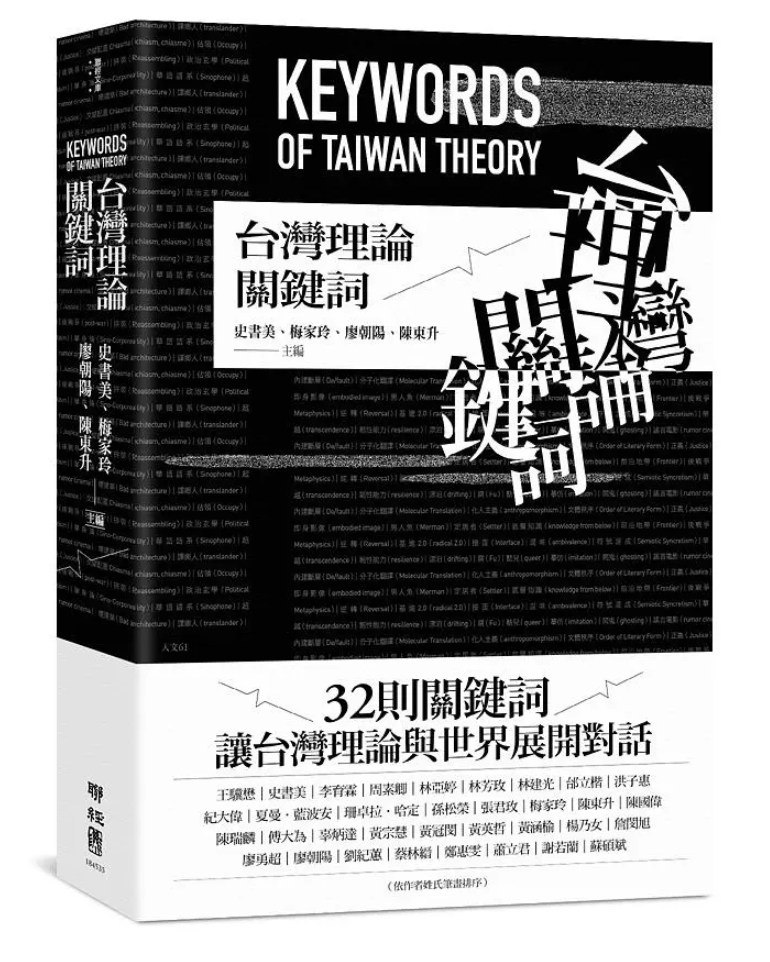
Taiwan theory keywords
Taiwan theory keywords
作者: Wang Chi-mao / Shu-mei Shih / Lee Yu-lin / et al.
發布者: Linking Publishing Company
發佈日期: 2019年3月10日
存貨單位 (SKU):区域研究(台港)
庫存不足:剩餘 2 件
無法載入取貨服務供應情況
Is there any theory in Taiwan? Are only those introduced from the West considered theories?
Under the global division of knowledge, with 32 keywords,
Taiwan is propelled to transcend its role as a dependent and imitator, allowing Taiwanese theories to engage in dialogue with the world.
How do we define theory? Are only those introduced from the West considered theories? Does Taiwan have its own theories? If so, what are their content, scope, and genealogy? If not, is Taiwan unable to transcend its role as a dependent and imitator under the global division of knowledge? If so, how can it resist this assigned role and transform into a producer of theory? Milan Kundera once pointed out that great nations have their own narrow-minded views, being overly confident and ignoring others, while small nations have their own narrow-minded views, believing they have nothing to contribute to the world. He said both are fallacies that need to be overcome. From this perspective, can Taiwan contribute to the world's theoretical field? Or, does Taiwan inherently possess theories, depending on how theory is defined, but due to the shackles of "recognition mechanisms," they have not been seen, or even seen by ourselves? How then can we see ourselves and be seen by others? Where is the position of Taiwanese theory between particularization and generalization? Can the conceptualization of local Taiwanese experiences be elevated to universal theories?
"Keywords of Taiwanese Theory," edited by Shih Shu-mei, Mei Chia-ling, Liao Chao-yang, and Chen Tung-sheng, attempts to uncover the possible relationship between "theory" and "Taiwan" as a method for Taiwanese knowledge studies. Starting from Taiwanese experience, this book aims to create, breaking away from outdated terminology, idioms, and foreign theoretical concepts, inventing new terms—keywords—to explore Taiwan's unique characteristics. Based on the premise that local is global, this book not only explores Taiwan's particularity but also hopes to provide a path from particularity to generality, in order to contribute to broader theoretical dialogues in the global context.
分享