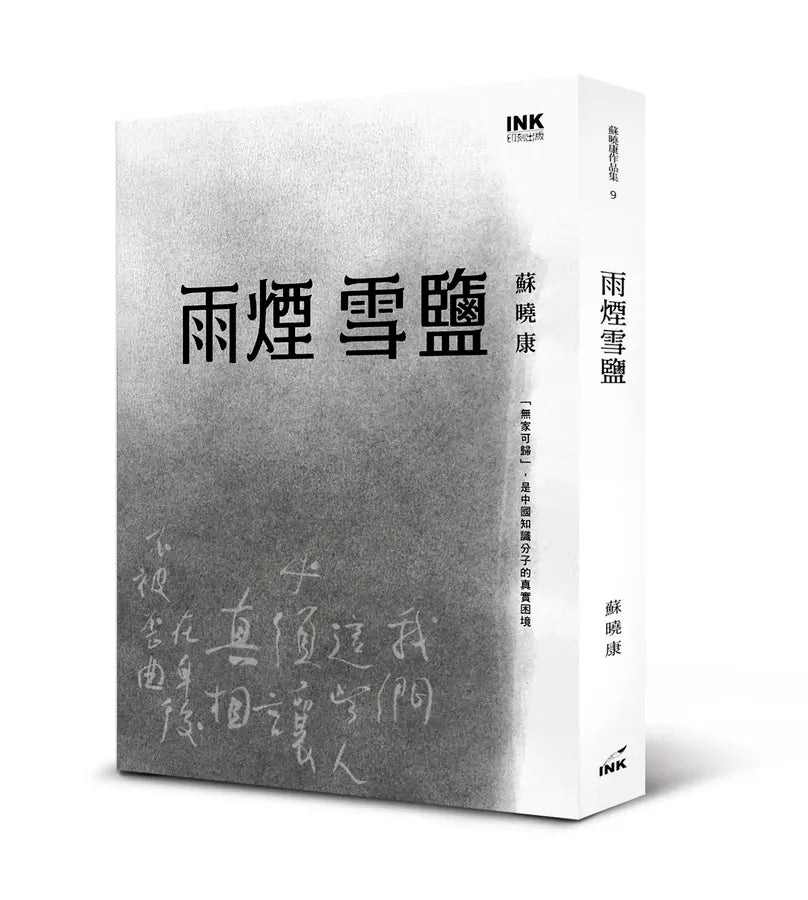
雨烟 雪盐
雨烟 雪盐
作者: 苏晓康
发布者: 印刻文学生活杂志出版股份有限公司
发布日期: 2025年3月24日
SKU:台港文学(台港)
低库存:剩余 2
无法加载取货服务可用情况
“Homelessness” is the true predicament of Chinese intellectuals. — Su Xiaokang
He returned from solitude to the world, flying between Europe, South Asia, Taipei, and North America. “Kyiv engulfed in flames” was once a fire in his memory, unexpectedly connected to a dark personal trajectory, another drowning while living in seclusion, still distraught and gnashing his teeth. Turning his head, he suddenly saw the world outside, another kind of desolation of blood and fire, East and West, history and thought, sorrow and fate.
Following "An Autobiography of a Soul's Ordeal" and "The Lonely Delaware Bay," Su Xiaokang continues to write about his life and experiences after leaving Delaware for Washington D.C. in "Rain Mist, Snow Salt." He returns from exile to the public square, lingering in student movements, student societies, and halls of learning. He also awakens from the countryside, startled to see various scholars, leaders, pioneers, charlatans, and old-timers in the market, transforming into myriad forms between angels and devils, swaying and roaming between countless extremes. He also laments the institutional trailblazers who are far from their homeland. The final chapter, "Restless Soul," looks back at "River Elegy" and "June Fourth," still with endless dilemmas.
“We must ensure that the truth is not distorted after we are gone.” This is what Fang Lizhi’s wife, Li Shuxian, told Su Xiaokang, recorded in the first chapter, “Dark World Shrouded in Mist.” Perhaps this is the reason why exiled “homeless” individuals, after experiencing terrifying calamities and witnessing the absurdities and corruption of politics and the world, insist on writing truthfully.
Su Xiaokang
Born in 1949 by the West Lake, he spent his youth at the foot of Jingshan in Beijing and his early adulthood in central China. He then began with "A Revelation of the Wilderness," leading the wave of "problematic reportage," attempting a writing style once called "Su Xiaokang style," which is a "panoramic," "collective," and "three-dimensional" "journalistic reportage," often dealing with "hard-hitting" major subjects, frequently producing explosive effects and promoting the "New Enlightenment Movement." Subsequently, he led the production of "River Elegy," questioning Chinese history and lamenting the decline of civilization, causing a profound resonance among hundreds of millions of people, creating a new television genre, and stirring up a "cultural debate" among Chinese people worldwide. He lived in exile for thirty years after 1989, never ceasing to ponder and write diligently. In 2021, he won the Taipei International Book Exhibition Award for "The Ghost Grinds."
His works include "An Autobiography of a Soul's Ordeal," "The Lonely Delaware Bay," "The Dragon-Slaying Era," "The Ghost Grinds," "Deep Alley of Xizhai," "A World of Pestilence," "Morning Whisper," and "Sea Lament."
分享