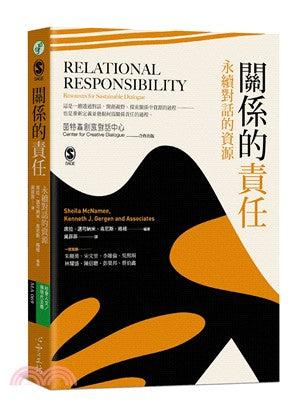
Responsibility of Relations: Resources for Sustained Dialogue
Responsibility of Relations: Resources for Sustained Dialogue
作者: 主席拉‧迈可纳米、肯尼斯‧格根编着
发布者: 心灵工坊
发布日期: 2019/11/19
SKU:旅行/生活/饮食(台港)
低库存:剩余 1
无法加载取货服务可用情况
In modern Western traditional ethics, whether in law, psychology, education, or social organization, responsibility is viewed as individual. However, this view of responsibility was no longer adequate to cope with the increasingly complex and challenging changes of globalization by the end of the 20th century. The authors and editors of this book, McNamee and Gergen, two social constructionist scholars, propose a new view of relational responsibility. The two authors begin by examining the discourse of individual responsibility, pointing out the limitations of traditional responsibility in terms of thought, ideology, or practical approaches, hoping to expand the scope of responsibility discourse and relevant practical methods, creating cracks in the old dialogue models, and attempting to initiate new dialogue models through these cracks. The book is divided into three parts: The first part explores the shortcomings of the traditional individual perspective, by viewing the dialogue process as co-creating meaning, thereby changing the perspective and discourse of individual accountability. It uses cases like child sexual abuse, which cannot be solved by simply holding individuals accountable, as a background to demonstrate how social constructionism can be used in dialogue to co-create meaningful discursive contexts. The second part includes various responses, both affirming and questioning, from professionals in psychology and social organization-related fields to the social constructionist view of relational responsibility. The third part is the two main authors' responses to the second part. Through dialogue, the two gain deeper insights, thereby expanding the relational view of responsibility involved in co-creating meaning. As McNamee and Gergen say, the final chapter provides a richer dimension and more possibilities for reflection on their initial discussion. In any case, from the perspective of social constructionist relational responsibility, this is an unfinished and ongoing discussion process, and the dialogue in the book is always open-ended, without a final conclusion.
分享