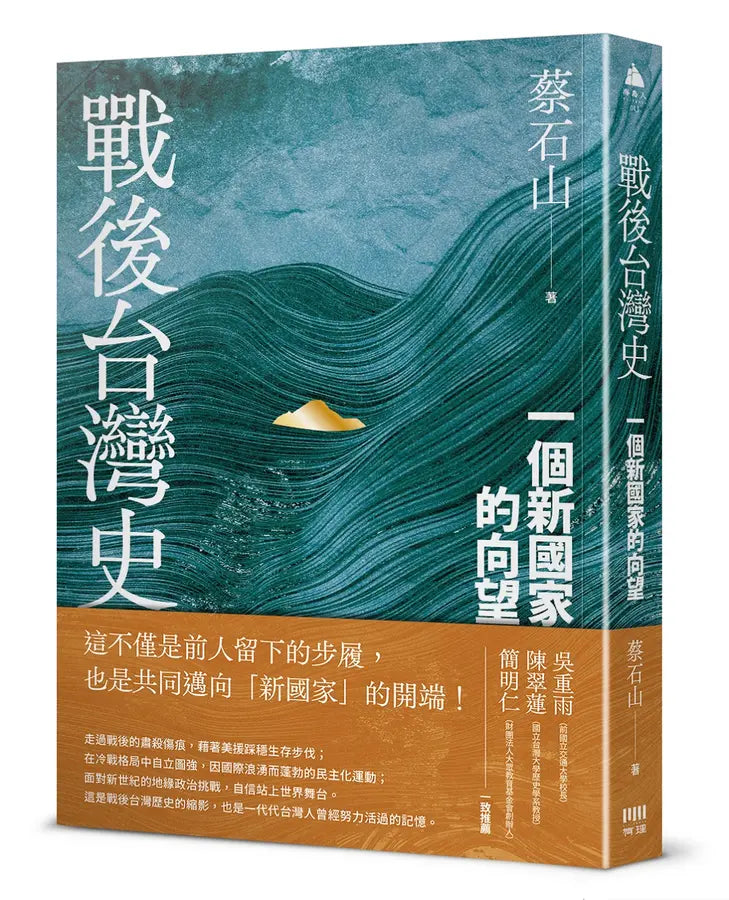
Postwar Taiwan History: Aspiration for a New Nation
Postwar Taiwan History: Aspiration for a New Nation
作者: 蔡石山
发布者: Rational Culture Co., Ltd.
发布日期: 2026年4月28日
SKU:区域研究(台港)
缺货
无法加载取货服务可用情况
Only by understanding post-war history can one thoroughly comprehend today's Taiwan!
Wu Chon-Yu (Former President, National Chiao Tung University)
Chen Tsui-Lien (Professor, Department of History, National Taiwan University)
Chien Ming-Jen (Founder, Mass Education Foundation)
──Highly Recommended
──After Japan surrendered in 1945, what happened during the seventy-day power vacuum before the official takeover by the Nationalist government that shaped the island's future destiny?
──As Taiwan experienced martial law, the White Terror, and waves of democratization, what was America's position? When the Six Assurances became history, what exactly did America change?
──From export processing zones to the technology industry, from an OEM island to a crucial chip hub, how did an island diplomatically isolated manage to grasp the key to world technology?
Post-war Taiwan is a new nation that emerged step by step amidst the pulls and pushes of the Cold War, authoritarian rule, democratic movements, and international politics. But what factors have shaped Taiwan's international position, political landscape, economic structure, and social and cultural features today?
The author argues that the composition of contemporary Taiwanese culture and its fundamental values are actually influenced by three major world civilizations: Chinese, Japanese, and American cultures. While there has been extensive discussion on the impact of Chinese and Japanese cultures on Taiwanese society, this book delves into how American factors propelled the formation of Taiwan's diverse and civil society, as well as the origin and evolution of the island's "third wave democracy."
This book cuts in from the post-1945 situation, spanning the Nationalist Party's arrival in Taiwan, the martial law system, the White Terror, the democratization movement, to Taiwan-US relations, cross-strait tensions, and the reorganization of the international order. It re-examines how Taiwan, under highly unfavorable conditions, gradually formed its current political subjectivity and social structure.
Based on extensive historical data and an international perspective, the book illustrates how Taiwan developed its unique democratic experience, civil society, and national imagination amidst US-China rivalry, military threats, and diplomatic isolation. The book not only discusses political elites but also writes about economic and technological development, the experiences of overseas students, and incorporates labor, women, indigenous peoples, media, and new technologies into its scope, presenting a complete post-war panorama from the social grassroots to the international stage.
分享