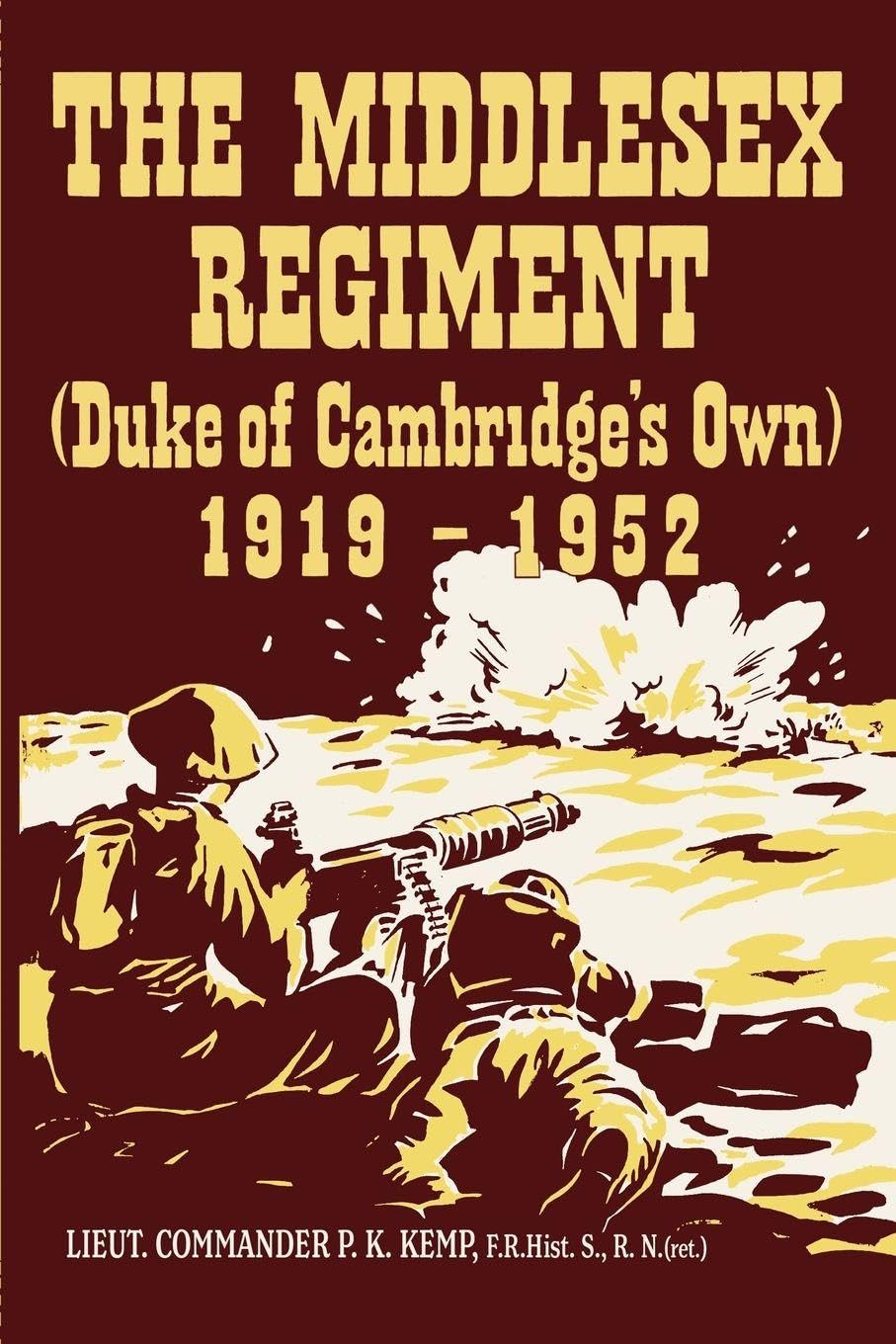
THE MIDDLESEX REGIMENT 1919-1952 (Duke Of Cambridge's Own)
作者: Lieut Commander Pk Kemp
发布者: Naval & Military Press
发布日期: February 16, 2026
SKU:Staff Picks & Surprises
低库存:剩余 1
无法加载取货服务可用情况
The period 1919-1952 marks a decisive phase in the history of the Middlesex Regiment, encompassing post-First World War contraction, imperial garrison service, doctrinal transformation, and sustained operational commitment through the Second World War and into the early Cold War. As detailed in P. K. Kemp's The Middlesex Regiment (Duke of Cambridge's Own) 1919-1952, the regiment adapted to shifting strategic demands while maintaining a continuous global presence.
Inter-War Years (1919-1939)
In the aftermath of the First World War, the regiment underwent significant reorganisation. The 3rd and 4th Battalions were disbanded in 1922, leaving the 1st and 2nd Battalions as the regular components. These units undertook extensive imperial garrison duties, serving in Germany, Egypt, Palestine, Shanghai, India, and Singapore. In 1937, reflecting evolving British Army doctrine, both battalions were converted to machine-gun roles. That same year, the Princess Louise's Kensington Regiment (Territorial Army) was formally affiliated with the Middlesex Regiment.
Second World War (1939-1945)
At the outbreak of war, the regiment was rapidly committed to global operations. The 1st Battalion, stationed in Hong Kong, was captured following the Japanese invasion in December 1941. Elsewhere, regular and Territorial battalions-including the 1/7th and 1/8th-served across multiple theatres, contributing to campaigns in Europe, the Middle East, and the Far East, underscoring the regiment's versatility and strategic reach.
Post-War and Korean War Era (1945-1952)
Following 1945, the Middlesex Regiment remained actively engaged in occupation duties and emerging Cold War commitments. This period culminated with service in Korea, from which the 1st Battalion returned in 1952, closing a chapter defined by continuous overseas service and institutional adaptation across more than three decades of conflict and transition.
Battle honours were as follows
The Second World War:
Dyle, Defence of Escaut, Ypres-Comines Canal, Dunkirk 1940, Normandy Landing, Cambes, Breville, Odon, Caen, Orne, Hill 112, Bourguébus Ridge, Troarn, Mont Pincon, Falaise, Seine 1944, Nederrijn, Le Havre, Lower Maas, Venraij, Meijel, Geilenkirchen, Venlo Pocket, Rhineland, Reichswald, Goch, Rhine, Lingen, Brinkum, Bremen, North-West Europe 1940 '44-45, El Alamein, Advance on Tripoli, Mareth, Akarit, Djebel Roumana, North Africa 1942-43, Francofonte, Sferro, Sferro Hills, Sicily 1943, Anzio, Carroceto, Gothic Line, Monte Grande, Italy 1944-45, Hong Kong, South-East Asia 1941
Korea 1950-51( 7th, 8th, 9th Battalions)
Naktong Bridgehead, Chongju, Chongchon II Chuam-Ni, Kapyong-chon, Kapyong.
分享